
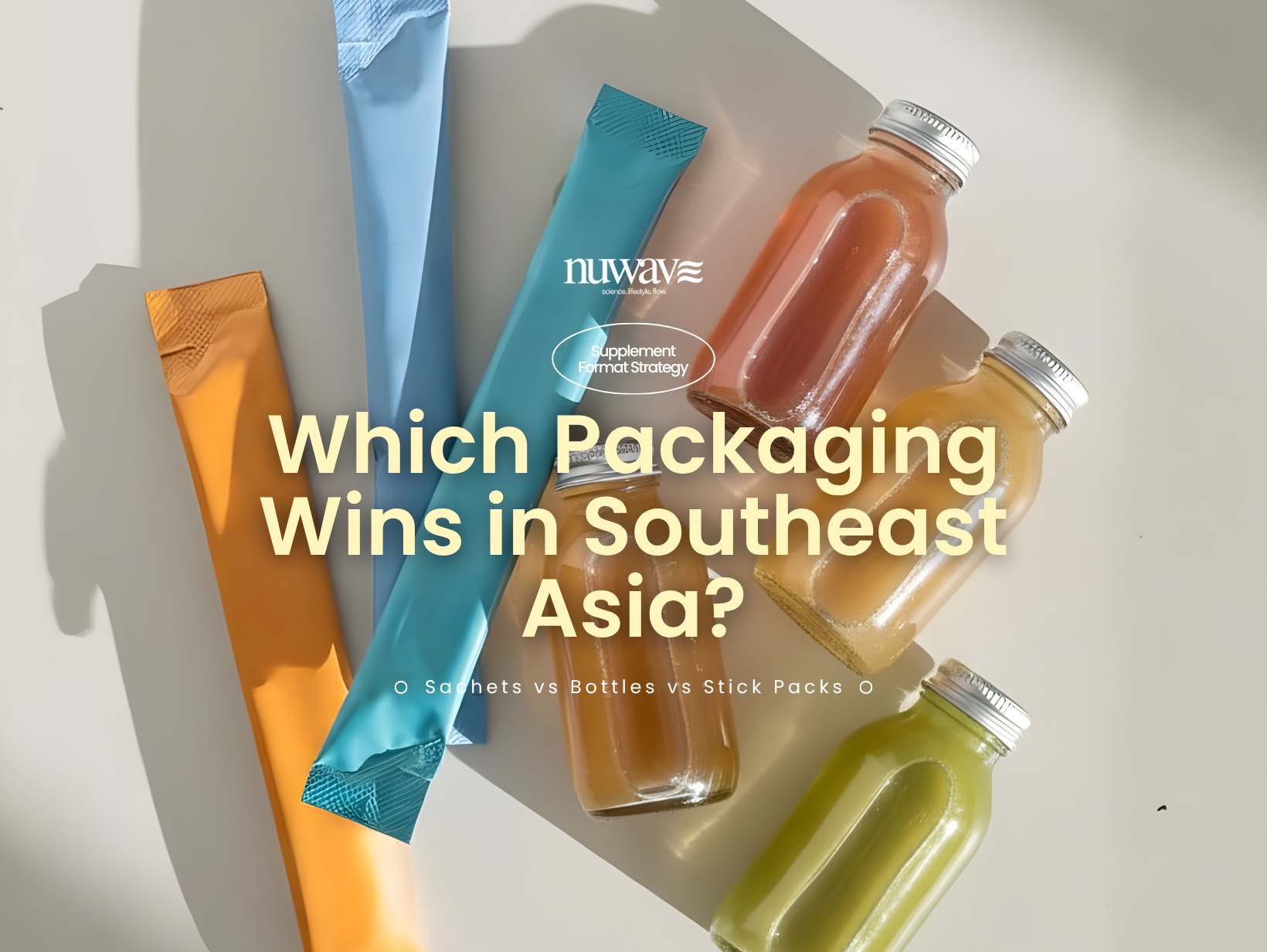
Why Packaging Format Matters in Southeast Asia
For supplement brands in Southeast Asia, packaging is not just a container—it is a commercial strategy.
In markets such as Indonesia, Vietnam, Thailand, and the Philippines, packaging format directly influences how a product is priced, distributed, trialed, and used. It affects entry price, portion control, portability, and even how a product fits into daily routines. For categories like kombucha powders, weight management drinks, collagen, and protein products, the choice between sachets, stick packs, and bottles can shape both acquisition and long-term retention.
For B2B brands and OEM clients, this makes packaging a cross-functional decision. It sits at the intersection of formulation, cost structure, channel strategy, and regulatory planning. A format that works in one market segment or channel may fail in another.
This article compares sachets, stick packs, and bottles through a practical lens—cost dynamics, consumer usage patterns, and formulation fit—specifically for Southeast Asian supplement brands. It also outlines when each format makes the most sense, and how working with an experienced OEM partner like NuWave can reduce risk when scaling across the region.

Market Context: Packaging and the “Sachet Economy” in SEA
Across Southeast Asia, packaging formats are closely tied to purchasing behavior.
One of the most important structural realities is the region’s “sachet economy,” particularly visible in countries like the Philippines. Consumers often purchase products in small, affordable units rather than larger packs, allowing them to manage daily cash flow and reduce financial risk when trying new products (World Bank, 2021).
This behavior extends beyond personal care and food into health and supplement categories. For supplement brands, this creates a strong case for single-serve formats such as sachets and stick packs, especially in entry-level or trial-focused SKUs.
At the same time, urbanization and rising disposable incomes are expanding demand for more premium formats. Bottles—particularly for capsules, gummies, and multi-serve powders—remain important in pharmacies, modern retail, and e-commerce, where consumers are more willing to evaluate value per serving and commit to longer-term use.
For B2B decision-makers, the key takeaway is this: SEA is not a single-format market. It is a multi-format environment where sachets, sticks, and bottles coexist, each serving different price tiers, channels, and usage occasions.
Format Overview: Sachets, Stick Packs, and Bottles
Sachets
Sachets are flat, single-portion packets typically made from multilayer films. They are widely used for powders, granules, and small liquid servings.
For supplement brands, sachets are most often associated with:
- Low entry price points
- Single-use convenience
- High-visibility merchandising (e.g., hanging strips, countertop displays)
They are particularly effective in traditional trade and value-oriented segments, where affordability and accessibility drive trials.
Stick Packs
Stick packs are narrow, elongated single-serve formats designed for clean pouring into bottles or cups.
They are commonly used for:
- Drink powders (hydration, collagen, kombucha, electrolytes)
- Beauty-from-within supplements
- Performance and lifestyle nutrition
Compared to standard sachets, stick packs often provide:
- Better pouring control
- More compact, portable form
- A more premium, modern visual identity
For many brands, stick packs sit between sachets and bottles—offering both convenience and stronger perceived value.
Bottles
Bottles—typically made from HDPE, PET, or glass—are the standard format for:
- Capsules and tablets
- Gummies
- Multi-serve powders
Their key advantages include:
- Reclosability
- Physical protection
- Flexible dosing
- Strong shelf presence
Bottles are especially relevant in pharmacy, modern retail, and e-commerce channels, where consumers are more likely to compare pack sizes and commit to higher upfront purchases.

Cost Dynamics: Beyond Material Pricing
For Southeast Asian supplement brands, packaging cost is not just about materials. It includes production, logistics, retail execution, and pricing strategy.
Material and Production Considerations
Flexible formats such as sachets and stick packs generally use less total material mass than rigid bottles, particularly when compared across equivalent serving counts. However, the exact cost advantage depends on:
- Fill weight
- Barrier requirements
- Film structure
- Production scale
Stick packs often use material more efficiently than wider sachets, but require specialized machinery.
Bottle formats, on the other hand, involve:
- Higher material input (resin or glass)
- Additional components (caps, liners, labels)
- More complex production lines (filling, capping, sealing, labeling)
These factors can increase both per-unit cost and capital expenditure.
Production and Operational Complexity
Single-serve flexible formats can be produced at high speeds using multi-lane machines, making them efficient for large-volume SKUs.
Bottle lines typically require more steps and equipment, including:
- Container handling
- Filling systems
- Capping and sealing
- Labeling and sometimes secondary packaging
For brands, this means that:
- Flexible formats may offer faster scale for single-serve products
- Bottles may require higher upfront investment but support multi-serve economics
Logistics and Retail Economics
Flexible packaging reduces shipping weight and volume, which is particularly important in Southeast Asia, where distribution networks can be fragmented and last-mile delivery costs are significant.
Advantages of flexible formats:
- Lower freight costs
- More units per pallet
- Easier distribution into small-format retail
Advantages of bottles:
- Strong shelf presence
- Better stacking in warehouses
- Higher perceived value in modern trade and e-commerce
Cost vs. Price-Point Strategy
Ultimately, the most important question is not which format is cheapest—but which format aligns with your pricing strategy.
- Sachets enable low daily price points and fast trial
- Stick packs support slightly higher pricing with added convenience and design value
- Bottles allow higher upfront pricing with better cost-per-serving economics
For SEA brands, aligning packaging with realistic consumer price thresholds is critical to both trial and repeat purchase.

Consumer Usage Patterns: How Format Shapes Behavior
Packaging format influences not just purchase decisions, but also how products are used.
Trial and First Purchase
Single-serve formats—especially sachets—reduce the barrier to entry. They allow consumers to try a product with minimal financial commitment.
For brands, this makes sachets and stick packs effective tools for:
- Market entry
- New product launches
- Sampling campaigns
Convenience and Daily Use
Portability is a key driver in urban Southeast Asia.
Stick packs and sachets are easy to carry and use in:
- Offices
- Gyms
- Travel settings
They eliminate the need for scoops or measuring, which simplifies usage.
Bottles, by contrast, are more suited to:
- Home use
- Shared consumption
- Flexible dosing routines
Perceived Value and Trust
Packaging also signals quality.
- Bottles often convey durability, safety, and premium positioning
- Stick packs can signal modern, lifestyle-oriented products
- Sachets are often associated with accessibility and value
However, design plays a major role. High-quality printing, materials, and structural design can elevate any format.
Retention and Adherence
For supplement categories where consistent usage is important—such as weight management, hydration, or beauty-from-within—packaging can influence adherence.
- Single-serve formats simplify routines and reduce dosing errors
- Multi-serve formats offer flexibility and long-term value
For many brands, this leads to a two-stage strategy:
- Use sachets or sticks for acquisition
- Use bottles for retention and subscription

Format Comparison for SEA Supplement Brands
| Factor | Sachets | Stick Packs | Bottles |
| Commercial role | Trial, entry-level SKUs | Lifestyle, on-the-go formats | Retention, premium SKUs |
| Price strategy | Low entry price | Mid-tier pricing | Higher upfront value |
| Consumer signal | Accessible, practical | Convenient, modern | Trustworthy, premium |
| Best-fit channels | Traditional trade, mini-marts | Convenience, gyms, e-commerce | Pharmacies, supermarkets, online |
| Formulation fit | Powders, small liquids | Powders (drink mixes) | Capsules, gummies, bulk powders |
| Tradeoffs | Lower perceived premium | Requires precise machinery | Higher cost and logistics |
Ingredient and Category Fit
Packaging decisions must align with formulation realities, especially in Southeast Asia’s hot and humid climate.
Kombucha and Probiotic Powders
For moisture-sensitive formulations:
- Barrier protection against humidity and oxygen is critical
- Single-serve formats help reduce repeated exposure after opening
Stick packs and sachets are often suitable because they:
- Protect each serving individually
- Support on-the-go consumption
Weight Management Products
Weight management products benefit from:
- Portion control
- Structured routines
Sachets and stick packs are effective for:
- Starter kits
- Daily-use drink mixes
Bottles are better suited for:
- Capsules
- Long-term regimens
Best practice: combine formats—single-serve for trial, bottles for maintenance.
Protein and Performance Nutrition
Protein powders often require larger serving sizes.
- Multi-serve rigid formats (bottles or jars) remain standard for bulk use
- Stick packs are increasingly used for travel-friendly servings and adjunct products (e.g., collagen, BCAAs)
For SEA brands, combining bulk and single-serve formats can create a more flexible product ecosystem.

When to Choose Sachets, Stick Packs, or Bottles
Choose Sachets When:
- Your priority is low entry price and mass-market reach
- You are targeting traditional trade or rural markets
- You need a fast trial mechanism
- You are launching a new product with uncertain demand
Pick Stick Packs When:
- You want a balance of convenience and premium perception
- Your product is a drinkable powder
- You are targeting urban, on-the-go consumers
- You are selling through e-commerce or lifestyle channels
Choose Bottles When:
- Your product requires reclosability or flexible dosing
- You are selling capsules, tablets, or gummies
- You are targeting pharmacy or modern retail channels
- You are building subscription or long-term usage models
Working with an OEM Partner Like NuWave
For Southeast Asian supplement brands, packaging is not a standalone decision. It affects formulation design, MOQ planning, pricing, regulatory compliance, and channel strategy.
An experienced OEM partner can help evaluate:
- Format suitability based on ingredient stability
- Cost implications across different pack sizes
- Production feasibility and scalability
- Regulatory alignment across SEA markets
NuWave supports supplement brands through:
- Ingredient sourcing and formulation
- Packaging format selection
- Manufacturing and scale-up
- Regional compliance and market alignment
This integrated approach helps reduce trial-and-error costs and accelerates time to market.
If you are planning your next supplement launch in Southeast Asia, working with a partner that understands both formulation and packaging can significantly improve your chances of success.
References
Grand View Research. (2024). Stick packaging market size, share & trends report. Retrieved from https://www.grandviewresearch.com
Mordor Intelligence. (2020). Stick packaging market – growth, trends, and forecast. Retrieved from https://www.mordorintelligence.com
U.S. Food and Drug Administration. (2023). Current Good Manufacturing Practice (CGMP) in manufacturing, packaging, labeling, or holding operations for dietary supplements (21 CFR Part 111). Retrieved from https://www.ecfr.gov
World Bank. (2021). Market study for Philippines plastics circularity: Opportunities and barriers. Retrieved from https://www.worldbank.org
Future Market Insights. (2025). Asia Pacific sachet packaging market report. Retrieved from https://www.futuremarketinsights.com
Data Bridge Market Research. (2019). Asia-Pacific nutraceutical packaging market. Retrieved from https://www.databridgemarketresearch.com
Nutraceutical Business Review. (2017). Vitamins and dietary supplements: Consumer packaging preferences. Retrieved from https://www.nutraceuticalbusinessreview.com
Western Packaging. (2025). Types of packages in nutraceutical manufacturing explained. Retrieved from https://blog.westernpkg.com


Leave a Reply