
For supplement brands in Southeast Asia, choosing a collagen source is not just an ingredient decision. It is a market-fit decision. The right collagen can strengthen product positioning, simplify certification, improve sensory performance, and help a formula match the expectations of a specific consumer segment. The wrong collagen can create avoidable friction in product development, brand messaging, and regional expansion.
That is especially true in Southeast Asia, where collagen products sit at the intersection of beauty, wellness, food culture, price sensitivity, and religious compliance. A collagen SKU that works in one market may not translate smoothly into another. Indonesia and Malaysia place a much heavier commercial weight on halal readiness and certification pathways, while Thailand and Singapore can support different balances of lifestyle branding, sensory experience, perceived quality, and price. Official halal systems in both Malaysia and Indonesia make clear that certification is not a casual add-on. It is a formal market-access and trust issue.
For B2B buyers, this means collagen should be evaluated through a wider commercial lens. Source matters, but so do processing, documentation, peptide format, taste management, application compatibility, and the final claim strategy. A brand that wants to win in Southeast Asia should not ask only, “Which collagen is best?” It should ask, “Which collagen source best matches our audience, regulatory pathway, pricing model, and finished-product format?”

Not sure which collagen fits your product concept?
Talk to NuWave’s formulation team to evaluate the best source for your target market.
Why collagen source matters more in Southeast Asia
Collagen is widely used across beauty-from-within, healthy aging, active lifestyle, and general wellness products. But from a brand-building perspective, different collagen sources carry different commercial meanings. Source can influence how easy the product is to position, how easy it is to certify, how easy it is to flavor, and how confident consumers feel about repeat use. That makes collagen sourcing especially important for private-label brands, OEM buyers, and product managers deciding how to enter or scale in Southeast Asia. Here, collagen sits at the intersection of:
- religion (halal compliance)
- beauty positioning (skin-first demand)
- sensory expectations (taste, smell, daily use)
- price sensitivity
- format preferences (sticks, jellies, drinks)
The region also brings a combination of pressures that B2B brands cannot ignore. On one side, collagen is often marketed through premium beauty and daily wellness narratives. On the other hand, brands still need formulas that are commercially practical at scale. Ingredient decisions must therefore support more than efficacy claims. They must support go-to-market execution. That includes consumer acceptance, retailer suitability, certification strategy, manufacturing feasibility, and the final product story.
For B2B brands, the key takeaway is simple: The best collagen is not the most premium one—it’s the one that fits your market, format, and positioning.
Understanding the three main source categories
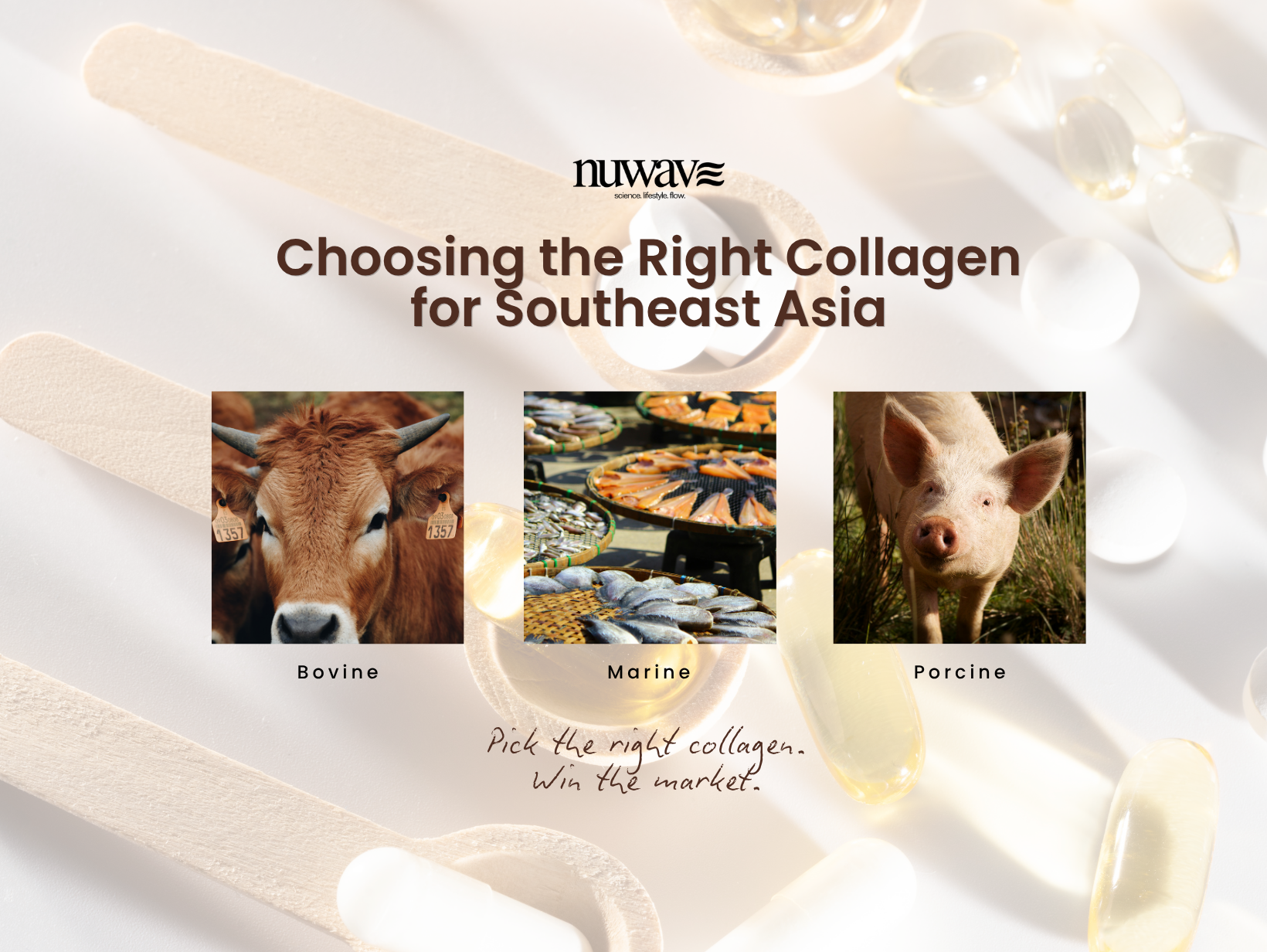
Before comparing options, it helps to define them correctly. In commercial supplement language, brands often treat “marine collagen” and “fish collagen” as the same thing. In practice, fish collagen is the most common marine collagen in supplements, but marine collagen is a broader category that can include collagen derived from other marine organisms as well. For most B2B supplement discussions, the comparison is best framed as marine/fish collagen, bovine collagen, and porcine collagen.
Marine or fish collagen
Marine collagen is commonly associated with fish-based raw materials such as skin or scales, and it is frequently positioned for beauty, skin, and premium wellness products. In the market, it often benefits from a clean, light, or beauty-oriented image, especially when the source and processing story are communicated well. It can also be commercially attractive in markets where porcine-derived ingredients face clear acceptance barriers. At the same time, marine collagen is not automatically simple. Formulators often need to pay close attention to odor control, flavor masking, and format selection because marine-based collagen products can carry fishy or other off-notes that affect acceptability.
Bovine collagen
Bovine collagen is one of the most commercially versatile options. It is widely used in food, nutraceutical, and wellness applications because it can fit a broad range of formats and brand positions. For many B2B brands, bovine collagen represents a middle ground: more accessible for mass or broad-wellness positioning than many premium marine concepts, while still capable of supporting serious product development across powders, sachets, capsules, and functional foods. However, in Southeast Asia, bovine does not bypass halal requirements. If a brand wants halal positioning, source traceability, slaughter compliance, and certification documentation remain essential.
Porcine collagen
Porcine collagen can be technically functional, but in Southeast Asia it carries the most obvious market limitations for brands targeting Muslim consumers or halal-sensitive channels. That issue is not only cultural. It is also commercial and regulatory. In markets where halal trust strongly shapes product selection, porcine collagen sharply narrows the audience and can complicate the brand’s ability to scale across countries, modern trade, and export channels. For some non-halal-targeted applications, porcine may still be considered, but brands need to weigh any technical or economic advantage against regional reputation, segmentation limits, and long-term portfolio flexibility.

The key decision factors for B2B collagen buyers
1) Halal fit and certification readiness
For Southeast Asia, halal should be treated as a product-design issue, not a marketing afterthought. Malaysia’s official halal system is managed through the Halal Malaysia portal, and Indonesia’s BPJPH has made clear that halal certification obligations matter for products entering the Indonesian market, including foreign-origin products under the timeline tied to October 17, 2026. That does not mean every collagen product needs the same strategy, but it does mean B2B brands should assess certification feasibility early, before fixing the source, artwork, and claims.
This is where source choice becomes commercially important. Porcine collagen is the hardest fit for halal-first brand strategies. Bovine collagen may work well, but only if the raw material chain and processing documentation support halal certification requirements. Marine or fish collagen can reduce certain acceptance barriers, but brands still need to validate the full finished-product pathway rather than assume that a marine source alone solves halal compliance. In other words, source permissibility and certifiable finished-product status are related, but not identical.
For brands targeting Indonesia or Malaysia first, the practical question is simple: which source gives the least resistance across sourcing, paperwork, consumer trust, and final certification? In many cases, that pushes halal-first portfolios toward marine/fish collagen or appropriately documented bovine collagen.
Planning for Indonesia or Malaysia?
NuWave supports collagen sourcing and formulation aligned with halal certification pathways.
2) Consumer perception and source story
Consumer perception is not just an advertising issue. It affects conversion, pricing power, and repeat purchase. The sensory study on commercially available collagen powders showed that collagen products could be grouped by source in sensory testing, and that marine collagen samples were associated with fishy, sour, bitter, and salty attributes that influenced acceptability. For brands, that means source affects not only storytelling, but also the user experience.
In practical B2B terms, marine collagen often supports strong beauty storytelling, especially in skin-focused products. Bovine collagen often gives brands a broader wellness frame that can sit comfortably in more mainstream offerings. Porcine collagen may still function technically, but it presents a steeper perception hurdle in many Southeast Asian settings, especially where religious sensitivity is high. The key lesson is not that one source is universally preferred. It is that each source comes with a different perception profile, and product strategy should reflect that from the beginning.
3) Cost and portfolio economics
Cost matters, but ingredient cost alone is not the right B2B metric. Buyers should assess cost in relation to target consumer, expected margin, retail price tolerance, claim architecture, and formulation complexity. A lower-cost raw material is not automatically the better commercial decision if it creates downstream problems in flavor masking, brand acceptance, or channel suitability. Likewise, a more premium source is not automatically the better choice if the audience is price-driven and the formula becomes difficult to scale.
This is one reason collagen strategy should be portfolio-based rather than ingredient-only. Brands may choose one source for a beauty-led premium line and another for a broader wellness or value line. In Southeast Asia, source-specific SKUs by market can sometimes make more business sense than trying to force a single collagen story across every country and audience.

4) Solubility and application compatibility
Collagen hydrolysates are used widely because hydrolyzed forms are more convenient for supplement and functional-food applications. In product development, however, “soluble” is not enough. Buyers need to know how the selected collagen behaves in the actual delivery system: room-temperature water, stick-pack powder, flavored sachet, jelly, gummy, RTD beverage, capsule fill, or tablet blend. Application performance can vary meaningfully once pH, flavor system, sweetener system, and processing conditions are introduced.
This is why B2B teams should avoid choosing collagen only from a specification sheet. A source that sounds attractive in a sourcing conversation may create challenges in cold-water dispersion, clarity, odor, or stability in the final product. In Southeast Asia, where convenient and sensory-friendly dosage forms are important, real application testing should happen early.
5) Taste and odor management
Taste remains one of the most underestimated drivers of repeat purchase in collagen products. Consumers may buy once for claims, but they come back for experience. The available sensory research shows that marine collagen can carry off-notes that need careful management. Separate research on fish collagen peptides also notes that off-flavor is a meaningful limitation for broader food-industry application. This does not make marine collagen a bad choice. It makes flavor strategy more important.
For B2B brands, the takeaway is operational. If the formula uses marine/fish collagen, plan for stronger odor control, masking, and flavor architecture. If the product is a ready-to-drink beauty shot, jelly, or gummy, the sensory burden may be even higher because the collagen experience is more exposed. A source with a strong market story still needs to survive the first sip.
Marine collagen can be powerful—but only if it tastes right.
NuWave helps optimize flavor systems and masking strategies for better repeat purchase.
6) Format fit
Format is where ingredient choice meets daily usage behavior. In Southeast Asia, collagen is sold across powders, sticks, capsules, tablets, gummies, jellies, and liquid formats. Each format changes how consumers perceive convenience, premiumness, and compliance with routine. Powders and sachets often work well for flexible dosing and cost control. Gummies and jellies can improve enjoyment but require more advanced taste management and manufacturing control. RTD or liquid beauty formats can support premium positioning but also raise the bar for stability and sensory quality.
From a B2B standpoint, collagen source should support the chosen format rather than fight it. Marine collagen may fit beautifully into a skin-focused stick or beauty shot if taste issues are managed properly. Bovine collagen may support wider use across mass-market powders and general-wellness formulas. The smartest decision is usually not the most fashionable source. It is the source that performs most reliably in the exact format the brand intends to scale.
Which collagen fits your brand type?
Beauty brands
Best fit: Marine / fish collagen
Why:
- aligns with skin, anti-aging, radiance positioning
- supports premium storytelling
But:
- requires strong sensory execution
Mass-market brands
Best fit: Bovine collagen
Why:
- cost-performance balance
- flexible across formats
- broad consumer acceptance
Premium brands
Best fit: Marine collagen
Why:
- stronger differentiation
- better storytelling
- aligns with high-end formats
But:
- must deliver on experience, not just positioning
Halal-first brands
Best fit:
- Marine collagen (simplest pathway)
- Certified bovine collagen (viable alternative)
Avoid:
- porcine collagen
Key rule:
Halal is a system decision, not a marketing claim.
Not sure which category your product fits best?
Get a tailored collagen recommendation based on your brand positioning and price target.

Avoid overclaiming source superiority
A common mistake in collagen marketing is overstating the superiority of one source over another. The recent Frontiers in Nutrition study comparing fish-, porcine-, and bovine-derived collagen hydrolysates found differences in peptide profiles and kinetics, but it also supports a more measured takeaway: bioavailability across these hydrolysates can be broadly comparable rather than proving a simple winner by source. For B2B brands, this is important. Source choice should be connected to brand fit, formulation needs, and market acceptance, not exaggerated “best source” claims.
That creates a stronger commercial message anyway. Buyers and consumers are more likely to trust a brand that explains why a source was chosen for their needs than one that relies on sweeping superiority language.
What this means for brands working with an OEM or ingredient partner
For most supplement brands, the fastest route to a commercially strong collagen product is not sourcing collagen in isolation. It is working with a partner that can connect source selection, certification considerations, format development, and launch execution. NuWave presents itself as an OEM/ODM nutraceutical partner and also lists collagen-related offerings, including essentide® collagen peptides and fish-derived collagen ingredients, across different product pages.
NuWave supports OEM supplement development in Southeast Asia, helping brands:
- select the right collagen source
- develop market-fit formulations
- navigate regional requirements

Conclusion
The best collagen source for a supplement brand in Southeast Asia depends on more than raw-material preference. It depends on who the product is for, how the brand wants to position it, how important halal readiness is, what format the formula will use, and whether the sensory experience supports daily repeat purchase.
Marine or fish collagen often fits beauty-led, premium, and many halal-conscious strategies, but it demands strong sensory management. Bovine collagen can offer a practical path for broad-wellness and mass-market concepts, provided certification needs are handled properly. Porcine collagen may still be technically usable, but in Southeast Asia it is the narrowest option from a brand and market-access perspective.
For B2B buyers, the smartest question is not which collagen is universally best. It is which collagen source gives the brand the best combination of acceptance, compliance, manufacturability, and commercial fit. That is the decision framework most likely to produce a collagen product that not only launches well, but stays competitive in Southeast Asia over time.
Talk to NuWave about your collagen product development
→ [Contact us / Start your project]
References
Coppola, D., Oliviero, M., Vitale, G. A., Lauritano, C., D’Ambra, I., Iannace, S., & de Pascale, D. (2020). Marine collagen from alternative and sustainable sources: Extraction, processing and applications. Marine Drugs, 18(4), 214. https://doi.org/10.3390/md18040214
Food and Agriculture Organization of the United Nations. (2023). Halal food systems and certification overview. https://www.fao.org
Frontiers Media S.A. (2024). Absorption of bioactive peptides following collagen hydrolysate intake: A comparative study of fish, porcine, and bovine sources. Frontiers in Nutrition. https://doi.org/10.3389/fnut.2024.1416643
Jabatan Kemajuan Islam Malaysia (JAKIM). (2024). Halal certification procedures manual. https://myehalal.halal.gov.my
Mahmud, M. S. M., Zabidi, N. A., & Rahman, N. A. (2022). Collagen products: Issue of halalness and the consumers’ tendency of acceptance. Journal of Contemporary Islamic Studies, 8(3), 25–36.
Rahman, N. A. (2017). Factors influencing purchase intention toward dietary collagen products in Bangkok, Thailand (Master’s thesis, Mahidol University). Mahidol University Institutional Repository.
Shoulders, M. D., & Raines, R. T. (2009). Collagen structure and stability. Annual Review of Biochemistry, 78, 929–958. https://doi.org/10.1146/annurev.biochem.77.032207.120833
U.S. Food and Drug Administration. (2020). Collagen and gelatin in food and dietary supplements. https://www.fda.gov
Yang, H., Wang, Y., Jiang, M., Oh, J. H., Herring, J., & Zhou, P. (2023). Characterization and sensory evaluation of collagen powders from different sources. Journal of Food Science, 88(5), 1892–1903. https://doi.org/10.1111/1750-3841.16822


Leave a Reply