
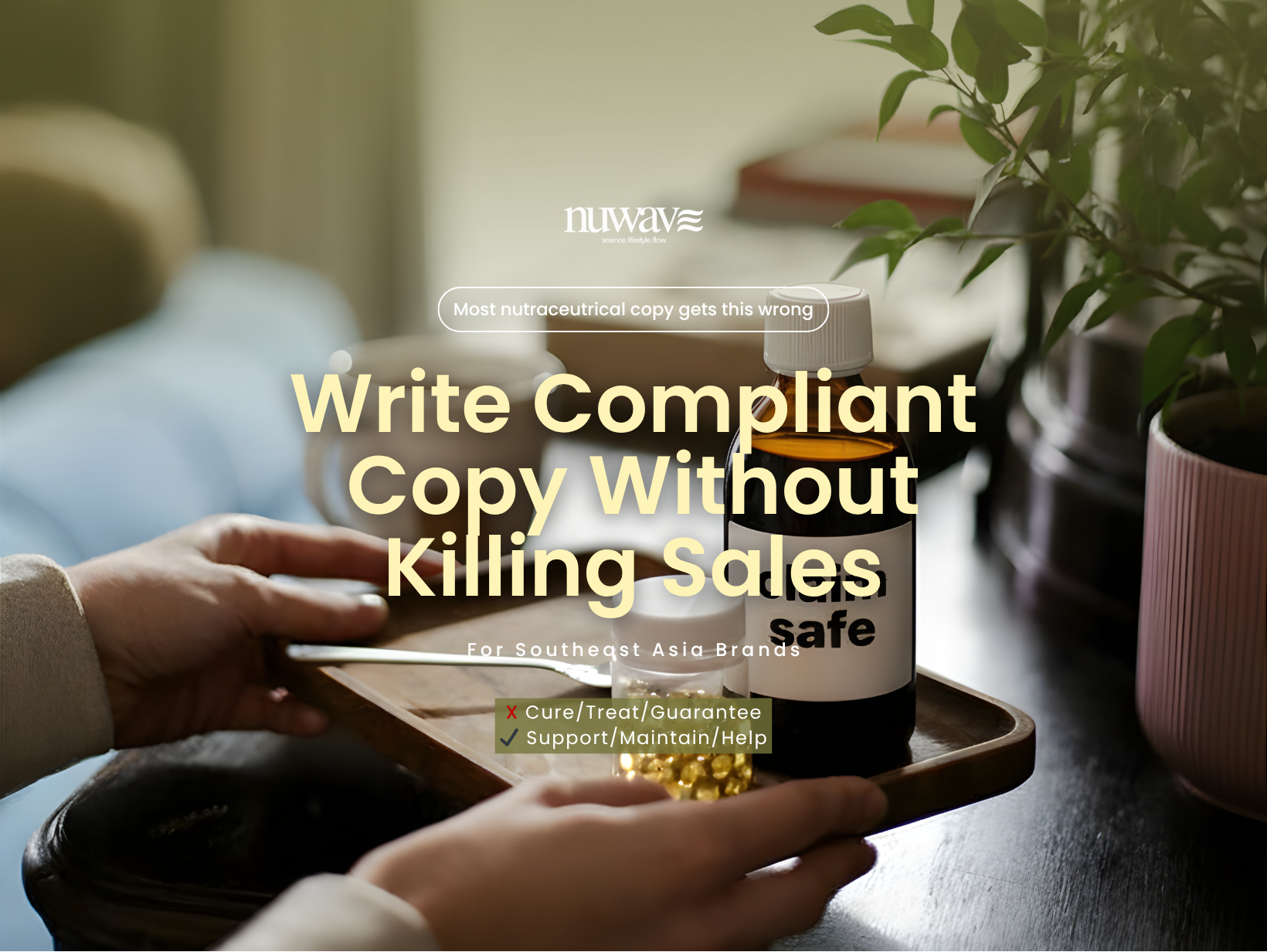
For B2B nutraceutical brands, compliant nutraceutical marketing copy in Southeast Asia is not just a legal safeguard. It is a commercial asset. Strong copy helps products get shortlisted by distributors, trusted by retail buyers, approved faster by internal regulatory teams, and scaled more confidently across multiple markets. Weak copy does the opposite: it creates friction, triggers rewrites, delays launches, and increases the risk of non-compliant claims appearing on landing pages, ads, brochures, and distributor sell sheets.
That is why the best nutraceutical marketers in the region do not treat compliance as the final review step. They build it into the writing process from the start. ASEAN has published harmonised guidance on health supplement claims and claim substantiation, but those regional principles still sit alongside country-level enforcement. In practice, that means your copy needs two things at once: a claim strategy that fits ASEAN-level guidance, and wording that can survive national review in markets such as Singapore and Indonesia.
This article shows B2B brands how to write claim-safe, conversion-conscious copy without flattening their value proposition. It covers what regulators actually care about, how to structure compliant pages and campaigns, what language to prefer, what to avoid, and how to train internal teams to write faster with less regulatory rework.
Looking to build compliant nutraceutical products for Southeast Asia? See how NuWave supports formulation, claim positioning, and go-to-market execution.

Why compliant copy has become a growth lever in Southeast Asia
Many brands still think of compliance copy as defensive writing: softer claims, more disclaimers, and less persuasive messaging. In reality, for B2B nutraceutical businesses, compliant copy often improves conversion quality. It sharpens positioning, reduces ambiguity, aligns marketing with formulation reality, and lowers the chance that a distributor, marketplace, retailer, or regulator will challenge the message later.
ASEAN’s claims guidance was built around a balance between consumer protection and science-led innovation. The document explicitly says health supplement claims should be truthful, evidence-based, proportionate to the type of claim, and not medicinal or therapeutic in nature. That is important for marketers because it means the region is not saying “do not sell benefits.” It is saying “sell benefits in a way that is supportable, appropriately framed, and consistent with the category.”
For B2B brands, that distinction matters. Buyers do not just want exciting copy. They want copy that can move through regulatory review, survive market expansion, and support a repeatable commercialization model across SKUs and channels. The more your copy reflects a disciplined claim strategy, the easier it becomes to scale product pages, export materials, co-branded distributor decks, and marketplace assets without rewriting from scratch every time.
What regulators actually care about in nutraceutical claims
A common mistake in nutraceutical copywriting is to focus only on the words themselves. Regulators care about wording, but they also care about the impression created by the full message. HSA defines a claim as any message or representation relating to a product’s indications, benefits, or action, whether on labels, advertisements, point-of-sale materials, or brochures. In other words, compliance risk does not live only in a product headline. It also lives in subheads, visuals, captions, testimonials, comparison lines, and even CTAs.
ASEAN’s guidance divides health supplement claims into three broad groups: general or nutritional claims, functional claims, and disease risk reduction claims. It also states that the level of evidence should be proportional to the type of claim, and that claims should meet the dosing recommendations reflected in the supporting evidence unless otherwise justified. This is a key point for B2B content teams: claim writing is inseparable from substantiation strategy. If marketing says more than the dossier can support, the copy is already unstable.
Singapore’s position is particularly clear. HSA states that health supplement claims should be limited to supporting or enhancing general health, or a function or biological activity of the body. They must not imply diagnosis, prevention, alleviation, treatment, or cure of disease, disorder, or medical condition. MOH reinforces this by stating that health supplements are used to support general well-being, not for preventing or treating diseases, and advertisements making such disease claims are not allowed.
Indonesia also takes a structured approach. BPOM’s 2022 claims guideline for health supplements is in force, and BPOM’s 2022 advertising regulation requires ad information to be objective, complete, not misleading, and aligned with the information approved in the distribution permit and labeling. That is a strong reminder for B2B brands that compliant copy is not just about “safe wording.” It is about consistency between formulation, approved claims, labeling, and promotional content.

Claim-safe language: how to move from risky promises to conversion-ready benefits
The fastest way to derail compliant nutraceutical marketing copy in Southeast Asia is to write like a drug marketer. Phrases such as “treats arthritis,” “reverses insomnia,” “cures fatty liver,” or “lowers blood sugar fast” move the product into medicinal territory or create a disease-treatment impression that health supplement frameworks do not allow.
The better move is not to strip the benefit out of the message. It is to reframe the message around support, maintenance, contribution, or healthy function. HSA’s current guidance explicitly allows action variants such as aid, assist, help, maintain, support, contribute to, nourish, supplement, improve, and promote, as long as the claim remains consistent with the category and is backed by relevant evidence.
For copywriters and brand teams, this gives you a practical rule: write benefits in a way that describes what the product supports, not what disease it claims to treat.
Here is the difference in practice:
- Risky: “Treats joint pain fast.”
Safer: “Helps maintain joint comfort and mobility in active adults.” - Risky: “Lowers blood sugar better than medicine.”
Safer: “Helps support healthy blood glucose levels in healthy adults.” HSA’s January 2026 health supplements guidelines include “Help support/maintain healthy blood glucose levels” for chromium as an example of an acceptable health claim. - Risky: “Cures insomnia overnight.”
Safer: “Supports relaxation and healthy sleep quality.” - Risky: “Prevents heart disease for life.”
Safer: “Supports cardiovascular health as part of everyday wellness.” - Risky: “Guaranteed weight loss without diet or exercise.”
Safer: “Supports weight-management efforts alongside a balanced routine.” HSA also states that claims must not imply a product can substitute for a healthy lifestyle.
This is where many teams get compliance wrong. They assume safer language means generic language. It does not. Strong compliant copy can still be specific. It can define audience, context, use moment, and benefit territory. For example, “supports post-exercise recovery,” “helps maintain healthy immune function during seasonal changes,” or “supports focus during demanding workdays” is still more commercially useful than vague wellness filler, provided the evidence and product context support the phrasing.
Structure matters: how to build compliant copy without flattening conversion
A lot of compliance problems begin with page architecture, not just sentence-level wording. When brands dump every benefit claim into the hero section, stack unsupported superlatives in comparison charts, and place science references beside aggressive disease-language CTAs, they create an overall impression that regulators may view as misleading. HSA specifically notes that claims must be evaluated in the context of the product materials in their entirety.
For B2B nutraceutical brands, a safer high-conversion structure usually looks like this:
1. Lead with the consumer outcome, not the disease frame
Open with the desired daily-life outcome. That keeps the page persuasive without putting the product in medicinal territory.
Example:
“Daily support for calmer nights and better next-day readiness.”
This is stronger than flat wellness copy, but still avoids implying treatment of a medical sleep disorder.
2. Follow with benefit pillars written as support claims
Use three to five short benefit blocks focused on support, maintenance, contribution, or healthy function. This mirrors the kind of claim structure regulators are more comfortable with.
Example pillars:
- Supports relaxation before bedtime
- Helps maintain healthy sleep quality
- Supports next-morning freshness
- Formulated for nightly wellness routines
3. Separate product facts from promotional language
Create a distinct product snapshot section for ingredients, dosage form, delivery format, recommended use, and key differentiators. This reduces the temptation to smuggle compliance risk into descriptive copy.
For B2B brands, this section is especially important because distributors and procurement teams want factual clarity fast. The cleaner your product facts are, the easier it is to build trust before the first sales call.
4. Use a science section with disciplined phrasing
This is where many brands overreach. HSA states that all health claims must be substantiated by relevant evidence held by the dealer, and specifically says open internet sources such as product websites and blogs are not acceptable evidence for substantiating claims. It also warns against using research results or partial quotations in a way that implies greater validity than the product can provide.
So your science section should explain mechanisms or evidence carefully. Good phrasing includes:
- “Formulated with ingredients studied for…”
- “Evidence suggests…”
- “Clinical research on this ingredient has shown…”
- “Supports [benefit] when used in line with the recommended serving.”
5. Close with a CTA that fits the category
A B2B nutraceutical page does not need a hyperbolic CTA to convert. It needs a CTA that feels commercially credible.
Examples:
- Explore OEM nutraceutical solutions for Southeast Asia
- Discuss compliant product positioning with our team
- Build your next health supplement line with claim-safe messaging from day one
That kind of CTA supports lead generation without creating regulatory noise.
Need help turning compliant claims into high-converting product pages?
NuWave supports Southeast Asia brands with formulation, claim positioning, and ready-to-market copy frameworks. Explore OEM nutraceutical solutions.

Practical example: a compliant page flow for a sleep-support nutraceutical brand
To make this concrete, imagine a melatonin-free sleep-support formula aimed at urban professionals.
A risky hero might say:
“Fix insomnia fast and wake up energized every day.”
A stronger compliant version would say:
“Gentle nightly support for relaxation, restful sleep quality, and better next-day readiness.”
Under that, the benefit blocks might read:
- Helps you unwind after long workdays
- Supports healthy sleep quality and duration
- Designed for nightly wellness routines
- Helps support next-morning freshness
The product-fact block can then list magnesium, L-theanine, botanicals, dosage form, and serving instructions. The science section can explain that selected ingredients have been studied for relaxation or sleep-quality support, while avoiding disease-treatment framing and avoiding blanket “clinically proven” language. HSA explicitly states that terms such as “Proven by Clinical Trials” and “Clinically Proven” are not allowed where there is an implied claim to treatment efficacy in relation to disease or an adverse condition.
Finally, the CTA can pivot to the B2B value proposition:
“Explore OEM development for compliant sleep-support products in Southeast Asia.”
This keeps the copy commercially useful for private-label, OEM, and brand-building audiences without drifting into consumer overclaiming.
Want to build similar compliant product pages across your portfolio? NuWave helps brands standardise claim-safe copy across SKUs and markets.
Using evidence without overpromising
One of the most useful lines in Singapore’s MOH guidance is that dealers may use authoritative reference texts such as official publications issued by authorities and published literature to support and substantiate product claims. That gives B2B brands room to build evidence-led marketing. But it does not give them permission to inflate what the evidence says.
ASEAN’s guidance is clear that the totality of substantiation matters, and that the strength of evidence should be proportional to the type of claim being made. It also says claims should meet dosing recommendations reflected in the supporting evidence unless otherwise justified. This means your commercial team cannot simply find one positive study on an ingredient and stretch that into a broad promise across all formats, doses, and target populations.
For B2B brands, the safest commercial habit is to build a simple evidence ladder for each product:
- What is the highest claim territory this product can realistically support?
- Is the evidence on the finished product or only on ingredients?
- Do the studied dose and ingredient form match the product?
- Can the claim survive being read by a regulator, distributor, and skeptical buyer at the same time?
This is also where many “high-converting” nutraceutical brands take unnecessary risk with phrases like “clinically proven,” “doctor recommended,” “works better than medication,” or “results guaranteed.” HSA warns against misleading use of scientific data, unqualified superlatives, and endorsements that imply advice or recommendations from healthcare professionals. ASAS’s advertising code also starts from a basic principle that ads should be legal, honest, truthful, and decent.

Regional nuances: Singapore, Indonesia, and why one ASEAN playbook is not enough
A regional strategy is useful, but a single copy template for all of Southeast Asia is risky. ASEAN provides harmonised guidance, yet the document itself notes that examples in scope are determined by the regulatory authority of each member state. That means the same core claim idea may need different phrasing, evidence packaging, or review pathways depending on where the product is sold and promoted.
Singapore is comparatively clear and marketer-friendly if you stay inside the health supplement lane. HSA publishes claims guidance, a list-based approach to acceptable claims, and general principles on truthfulness, evidence relevance, and misleading presentation. Singapore also links advertising practice to broader ad standards through SCAP.
Indonesia requires equal discipline, but from a different operational angle. BPOM’s claims guideline is active, and its advertising regulation requires that ads be objective, complete, not misleading, and consistent with the information approved in the distribution permit. BPOM also runs SIREKA, an electronic ad registration system for traditional medicines and health supplements, which signals that ad workflow and approval discipline matter in practice, not just on paper. SIREKA also publishes processing timelines for certain categories of ad submissions.
For B2B brands, the operational lesson is simple: build one regional claim framework, then localize responsibly. Do not localize by translating risky claims into another language. Localize by adapting supported claims to the regulatory logic, evidence expectations, and ad processes of each market. That is the real difference between scalable brand systems and constant rework.
How to build an internal playbook for compliant, conversion-focused copy
The most mature nutraceutical brands do not solve compliance line by line. They solve it systemically.
Start by defining claim territories for each product line. Separate what the formulation can support from what marketing wants to say. Then classify each claim as general health, functional support, or higher-risk territory requiring much stronger substantiation.
Next, create an approved language bank. This should include preferred verbs such as supports, helps maintain, contributes to, promotes, aids, assists, and category-specific targets such as joint mobility, immune health, cardiovascular health, healthy blood glucose levels, digestive comfort, and relaxation where those targets can be supported. It should also include banned constructions: cure claims, disease-treatment language, guarantee language, unqualified superlatives, drug comparisons, and “clinically proven” phrasing where the impression becomes medicinal or misleading.
Then create channel templates. Product pages, distributor decks, ecommerce bullets, paid ads, and brochures all create different compliance risks. Your playbook should show where product facts live, where science copy sits, which headlines are acceptable, and what approval checks are required before publication.
Finally, review the playbook regularly with regulatory, commercial, and product-development teams. Compliance frameworks evolve, guidance gets updated, and brand portfolios expand into new claim territories. The teams that move fastest are usually the ones that standardize their language before campaigns go live.
Many brands accelerate this process by working with OEM partners who align formulation, claims, and marketing early—reducing rework later.

Conclusion: compliance should strengthen conversion, not suppress it
The best compliant nutraceutical marketing copy in Southeast Asia does not read timidly. It reads credible. It stays inside the health supplement category, uses supportable verbs, aligns claims with evidence, respects market-level rules, and still gives buyers a clear reason to care.
Planning a nutraceutical launch in Southeast Asia?
Work with NuWave to align your formulation, claims, and marketing copy from day one—so you can scale faster without costly compliance rework. Talk to our OEM team about your next product.
References
Advertising Standards Authority of Singapore. (n.d.). Code: Singapore Code of Advertising Practice. https://asas.org.sg/About/Code
Association of Southeast Asian Nations. (n.d.). ASEAN guidelines on claims and claims substantiation for health supplements (Version 2.0). https://asean.org/wp-content/uploads/2017/09/ASEAN-Guidelines-on-Claims-Claims-Substantiation-HS-V2.0-with-discla….pdf
Health Sciences Authority. (2025, January). Guidelines for claims and claims substantiation of health supplements and traditional medicines (GL-CHPB-1-005 Rev. No. 004). https://www.hsa.gov.sg/docs/default-source/hprg-tmhs/chpb-tmhs/tmhs_claims_guidelines.pdf?sfvrsn=a9da9b67_11
Health Sciences Authority. (2026, January). Health supplements guidelines. https://www.hsa.gov.sg/docs/default-source/hprg-tmhs/hs_guidelines.pdf?sfvrsn=72e4bbd0_17
Health Sciences Authority. (2024, November 13). Health supplement claims. https://www.hsa.gov.sg/health-supplements/claims
Ministry of Health Singapore. (2026, March 20). Health supplements advertisements requirements. https://www.moh.gov.sg/newsroom/health-supplements-advertisements-requirements/
Badan Pengawas Obat dan Makanan Republik Indonesia. (2022). Peraturan Badan Pengawas Obat dan Makanan Nomor 19 Tahun 2022 tentang Pedoman Klaim Suplemen Kesehatan. JDIH BPOM. https://jdih.pom.go.id/view/slide/1399/19/2022/312351bff07989769097660a56395065
Badan Pengawas Obat dan Makanan Republik Indonesia. (2022). Peraturan Badan Pengawas Obat dan Makanan Nomor 34 Tahun 2022 tentang Pengawasan Periklanan Obat Tradisional, Obat Kuasi, dan Suplemen Kesehatan. JDIH BPOM. https://jdih.pom.go.id/download/rule/1450/34/2022/Peraturan%20Badan%20Pengawas%20Obat%20dan%20Makanan%20Nomor%2034%20Tahun%202022%20tentang%20Pengawasan%20Periklanan%20Obat%20Tradisional%2C%20Obat%20Kuasi%2C%20dan%20Suplemen%20Kesehatan
Badan Pengawas Obat dan Makanan Republik Indonesia. (n.d.). SIREKA: Sistem Informasi Registrasi Iklan Obat Tradisional dan Suplemen Kesehatan. https://sireka.pom.go.id/
Badan Pengawas Obat dan Makanan Republik Indonesia. (n.d.). Alur pendaftaran iklan. SIREKA. https://sireka.pom.go.id/general/process


Leave a Reply